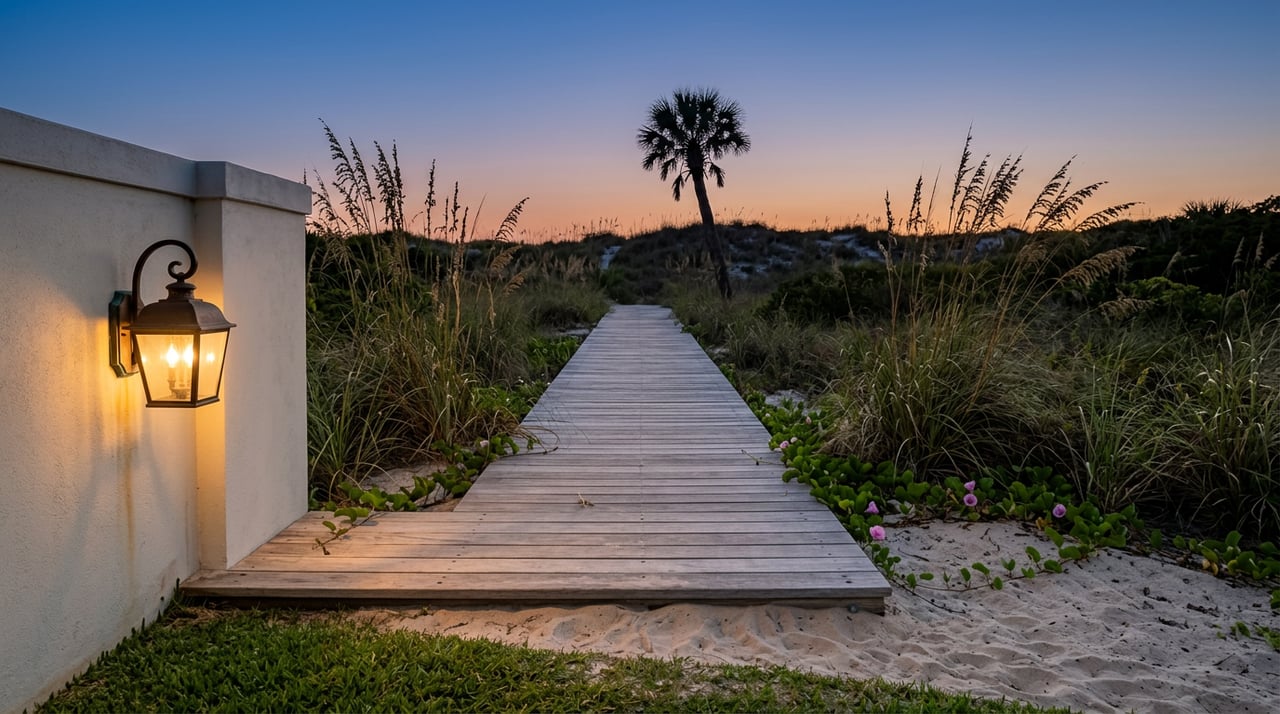
Walk south along Gordon Drive toward the water in the last hour before sunset and you will still reach sand. That has not changed. What has changed is what happens after you get there.
For most of Naples, the pier rebuild reads as a beach-access story: is it open, where do I park, when does it come back. For Aqualane Shores, that framing misses the point. The neighborhood's own beach accesses at 14th through 18th Avenues South, along with a quieter path at 21st Street South and Gordon Drive, sit several blocks south of the pier at 12th Avenue South and were never routed through the pier's parking lot to begin with. Residents here were never depending on that lot for a way onto the sand. What they were depending on was a destination at the far end of the evening walk, a specific bench, a fishing rail, a shelter where the walk used to stop and turn around. That destination has been a fenced work zone since January, and the construction log tells you almost exactly what is happening inside that fence right now and how much longer it holds.
A structure that has done this before
The pier has never been a permanent fixture so much as a recurring one. Originally built in 1888, it has been rebuilt after hurricanes in 1910, 1926, 1944 and 1960, reconstructed again in 2015, then damaged by Hurricane Irma in 2017, an event that led the city to extend the life of the aging pilings with modern jackets rather than rebuild outright. Hurricane Ian ended that patching approach. The storm destroyed roughly 460 feet of the structure, with about 140 feet, including the end shelter and more than 30 pilings, lost to the Gulf entirely. Only about 100 feet reopened that November, a fraction of what residents had walked for decades. What is underway now is, by Gulfshore Business's count, the seventh full reconstruction of the pier since 1888.
That history matters for one reason: it tells you this rebuild is not an anomaly the neighborhood has to weather once. It is the pattern. The walk has ended at that same point through six previous rebuilds. It will again.
What the construction log actually shows
The city's project page is updated with dated entries rather than vague progress language, and reading them in sequence tells a more specific story than "under construction":
- December 12, 2025: FEMA obligates funding for the rebuild
- January 5, 2026: demolition and the notice to proceed begin
- April 24, 2026: 59 concrete pilings are deployed at Wasmer Reef, expanding an artificial reef first established in 2015, using material recycled from the old pier
- May 5, 2026: a month-long diving initiative begins to clear debris, including buried pilings from a 1990s repair, ahead of new pile installation
- June 17, 2026: crews begin assembling a trestle, a bridge-like temporary walkway, along the south side so work can continue even when offshore barges have to shelter from weather
- June 26 and July 9, 2026: the first two concrete pours are completed for the bents, the vertical piling clusters capped by a crossbeam that will carry the new deck
Read plainly, the early months went to clearing what was actually in the water before anything new could go in, which is why visible pouring didn't start until early summer. Since then the pace has picked up, and the trestle means that pace should hold through the rest of hurricane season rather than stall every time weather pushes the barges back to shore. The city describes the build as roughly 18 months from the demolition start, which puts a realistic return somewhere around the middle of 2027, not next season and not this one.
The pier that comes back will not be identical
Part of why the timeline matters is that the replacement is not a like-for-like repair. The new design raises the structure to reduce future storm exposure, and it adds an underwater camera for wildlife viewing, shaded seating, and ADA-compliant restrooms. It also drops the permanent food concession that used to sit at the midpoint. Naples City Council opted for a portable cart instead, after concluding there was no room in the footprint for anything larger. For a neighborhood that measures a walk partly by what waits at the end of it, that is a small but real change to the ritual, not just the structure.
What the detour actually looks like
While the pier itself stays fenced, the city has kept pedestrian access to the sand open through two specific points: Broad Avenue South and 13th Avenue South, both with restrooms available. The western third of the pier's parking lot remains open to the public. The eastern two thirds, closer to the active work, does not. For anyone walking down from Aqualane Shores rather than driving in, that means the beach is reachable exactly as it always was. It just means the last stretch runs alongside a working marine construction site instead of ending at open water.
There is one more detail worth knowing if you have ever sat on a specific bench on that pier. Many of the benches were damaged by Ian, and the ones that survived have been removed and put into storage rather than left in place. Residents or plaque owners who want their bench back, or who simply have questions, are directed to reach out to Roxanne Nieto in the city's Community Services department. It is a small bureaucratic detail, but it is the kind of thing that only matters if you actually live close enough to have paid for one.
That closeness is the reason this rebuild has registered so personally along this stretch of coast. As Erica and Will Hayden, who met on the pier years ago, put it to WINK News on the day the city issued its notice to proceed:
"Naples Pier represents love and peace and connection."
That sentiment is the reason the missing endpoint registers at all. Nobody in Aqualane Shores has lost the beach. What's changed is that the walk that used to have a natural stopping point now runs past a construction fence instead, at least for a while longer, and the dated log of pours and pilings is the closest thing to an honest answer for how much longer that is.
What stays the same in the meantime
Third Street South, a few short blocks inland from the water, keeps its own rhythm regardless of what the pier looks like on a given week. The dining, galleries, and Saturday market there don't depend on pier access any more than the neighborhood's own beach paths do. If the walk used to be pier-and-back, this is a good season to let it end at Broad Avenue South or 13th Avenue South instead, watch the same sunset from a slightly different patch of sand, and pick the old route back up once the bents are capped and the deck goes down sometime around the middle of 2027.
If you are weighing what a rebuild like this actually means for a specific stretch of Naples waterfront, whether you already live here or you are watching this pocket of the coast from a distance, that is the kind of granular, on-the-ground read the Taranto Team builds every neighborhood conversation around. Schedule a private consultation with us when you want that same level of detail applied to your own corner of Naples.